Showing posts with label U K. Show all posts
UK begins injecting AstraZeneca and Oxford vaccine

UK begins injecting AstraZeneca and Oxford vaccine

Coronavirus: UK begins injecting AstraZeneca and Oxford vaccine


British authorities have ordered 100 million doses of AstraZeneca-Oxford vaccine, of which 520,000 are ready on Monday


The Pfizer-BioNTech vaccine has already been injected into more than one million Britons since the launch of the vaccination campaign in early December. On Monday, the UK becomes the first to give its population the vaccine from the British laboratory AstraZeneca and the University of Oxford against Covid-19, while considering a new severe round of screws to curb the worsening of the pandemic.


AstraZeneca-Oxford's vaccine is less expensive, easier to store and therefore more suitable for a large-scale immunization campaign than those of its competitors Moderna and Pfizer-BioNTech, already approved and distributed in several countries, including the United States.


British authorities have ordered 100 million doses of AstraZeneca-Oxford's vaccine, of which 520,000 are ready on Monday, according to the Department of Health. In England, hundreds of new vaccination centres are due to open this week, in addition to the 730 already in place.


"I am delighted today to launch the Oxford vaccine, inherited from British science," Health Minister Matt Hancock said in a statement on Monday. "This is a turning point in our fight against this horrible virus and I hope it will give everyone hope that the end of this pandemic is in sight."


The AstraZeneca-Oxford vaccine was also approved by Argentina as well as India on Sunday, which will allow the country of 1.3 billion people to start one of the world's most massive immunization campaigns. India,where the Covid-19 has claimed more than 150,000 lives, wants to immunize up to 300 million people by mid-2021.


Temperature issue


The AstraZeneca-Oxford vaccine has the advantage of being inexpensive (about 2.50 euros per dose). It can also be stored at the temperature of a refrigerator, unlike Moderna and Pfizer-BioNTech vaccines, which can only be stored at very low temperatures in the long term (-20 degrees Celsius for the first, -70 degrees Celsius for the latter).


However, its authorisation within the European Union is not expected to take place in January, according to the European Medicines Agency (EMA). The United States,for its part, does not plan to approve it until April.


With more than 75,000 deaths, the UK is one of the most bereaved countries in Europe by coronavirus. Nearly 55,000 more people tested positive for the virus in 24 hours, exceeding the 50,000 threshold for the sixth day in a row, according to the latest official data released on Sunday. The rapid expansion of the epidemic, attributed to a new variant of the virus, has led British Prime Minister Boris Johnson to consider stricter restrictions.


"We may have to do things in the coming weeks that will be more difficult in many parts of the country," Boris Johnson told the BBC on Sunday. He added that the closure of schools, a measure taken at the end of March during the first wave of the pandemic, "is one of those things."


Egypt chooses Chinese vaccine


Egypt, the Arab world's most populous country with some 100 million people, has announced that it has approved the vaccine developed by China's Sinopharm. Mexico, meanwhile, reported that more than 20% of the country's health care workers, or about 28,000 people out of 150,000, had already received a first dose of the Pfizer-BioNTech vaccine.


According to figures published by their manufacturers, Sinopharm's vaccine is 79% effective, Pfizer-BioNTech's 95% and Moderna's 94.1% effective. AstraZeneca-Oxford, for its part, claimed an efficacy rate of 70%, but that could reach 100% with two doses. While the arrival of vaccines gives hope of an improvement at the beginning of the year, the production and supply rates are still far from satisfactory.


The vaccination campaign in the United States is ramping up and could reach one million injections a day, officials said Sunday in the face of criticism of its initial delay, in a country that has just passed the 350,000-dead mark.


Inadequate production


The European Union on Saturday acknowledged a "global shortfall" in vaccine production capacity, saying it was "ready to help" to increase vaccine production capacity. For Hungarian Prime Minister Viktor Orban, however, it is the pace of the EU's acquisition of vaccines that is at issue. Products "were available earlier in Canada, the United Kingdom and Israel," he said on Sunday.


In France, Professor Mehdi Mejdoubi, from the hospital in Valenciennes (north), does not understand "why there is such a gap with Germany: Germany vaccinates 20,000 people a day, we are 50 people vaccinated per day". Since last Sunday, more than 238,000 people (238,809) have been vaccinated in Germany, according to the Robert Koch Institute for Health Watch.


South Africa, also hard hit by the second wave of the pandemic, hopes to get its first vaccines in February but the timing will depend on the outcome of ongoing negotiations with several pharmaceutical companies, the health minister announced on Sunday.


In recent weeks, the South African government has come under fire, including from health experts in the country, for delaying the process of acquiring vaccines against Covid-19. The pandemic has killed at least 1,835,824 people worldwide and more than 84,508,990 cases of infection, according to a report by AFP from official sources on Sunday.


Source:- Flash News and News Agencies
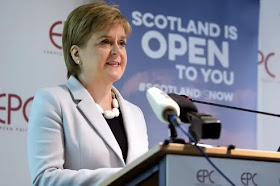
Scotland hopes to join EU as an independent nation

Scotland hopes to join EU as an independent nation

Brexit: Scotland hopes to 'join' EU as an independent nation


Majority of Scots are in favour of independence, according to latest poll


Scottish First Minister Nicola Sturgeon said on Saturday she hoped Scotland would gain independence and "join" the European Union,stressing that Brexit had been against the will of the Scots, who had overwhelmingly opposed it in the 2016 referendum. "We are now suffering a hard Brexit against our will, at the worst possible time, in the midst of a pandemic and an economic recession," Nicola Sturgeon lamented on the website of her pro-independence SNP party, two days after the UK left the single market and customs union.


She reiterated her determination to hold another referendum on Scottish independence, after the one lost by her camp in 2014, when 55% of Scots said "no" to independence. But the decision to hold such a referendum rests with British Prime Minister Boris Johnson,who strongly refuses. However, a broad SNP victory in next May's local elections would increase pressure on London to accept a new consultation. According to the latest survey conducted by the Savanta ComRes Institute for The Scotsmannewspaper in mid-December, 58% of Scots now support a break with the UK, unprecedented.


"We didn't want to leave"

"As an independent member of the European Union, Scotland would be a partner and could build bridges - not just a bridge to building a stronger economy and a fairer society, but also a bridge to facilitate EU-UK relations," Nicola Sturgeon said. While the British as a whole voted 51.9% for Brexit in 2016, the Scots had opposed 62% of leaving the European Union.


With Brexit, "our citizens will be less safe and their right to work, study and live elsewhere in Europe will be restricted," she lamented, pointing out that 2,000 Scots had participated last year in the Erasmus university exchange programme, which the UK government has given up and replaced it with its own international programme. "We didn't want to leave and we hope to join you soon as an equal partner," Sturgeon said.


Source:- Flash News and News Agencies

What will change on 1 January for European citizens

What will change on 1 January for European citizens

Brexit: Passport, permit, phone... What will change on 1 January for European citizens


We explain the main changes that come into effect this Friday


On 24 December, the UK and the European Union reached a post-Brexit deal, narrowly avoiding a "no deal" with dramatic consequences.

From 1 January 2021, on Friday, the UK will exit the common market, leading to many changes, notably in trade relations.

And for us European citizens, what does that change? "20 Minutes" takes stock of the practical questions you're asking yourself.


The time has finally arrived. More than four years after the British referendum and after months of negotiations, the European Union and the United Kingdom reached an agreement, in extremis,last week. The new rules governing the post-Brexit relationship between London and Brussels are due to come into force on 1 January.


If we have heard a lot about fishing,trade or how to deal with future conflicts, Brexit will bring about a series of concrete changes for the French and the British. Will you be able to go to the UK with your passport? What about expats? Will you need an international driver's license? 20 Minutes takes stock of what will change concretely from Friday for you, European citizens.


What document do I need to submit to cross the Franco-British border?


No more IDs when you board the Eurostar in a few months. Until 1 October 2021, you will be able to continue to travel with the same national identity card or your valid passport, but after that date, the French will have to present a passport to cross the border, the government explains on the portal dedicated to Brexit.


For visas, as a French citizen, you will not need them for a visit to the UK, if it does not last more than six months. This will also be the case for professional visits, training, conferences, seminars and short-term workshops. Conversely, if you are travelling to the UK to work or for a stay of more than six months, a residence permit will be required.


The British will have to carry a valid passport, as well as a health insurance certificate proving that all medical expenses are covered during the stay.


Could I drive in the UK with my French licence?


There is still some uncertainty on this issue. According to the government's website, the French licence is expected to continue to be recognised in the UK after 1 January. As this point is "still under negotiation", the authorities recommend that an international driver's licence be issued from 1 January 2021.


As a French expat, can I stay in the UK?


If you are French or European and have moved to the UK before 31 December 2020, a special scheme has been put in place to help you obtain your resident status. From 1 January, a points system based on several criteria will decide whether you can stay or not: age, English language level, level of education... To obtain a visa valid for five years, you will need to have a job offer from a company authorised by the UK Home Office with a salary of more than 26,500 pounds (22,930 euros) per year.


I am a European student, can I go to the UK?


Yes, but under certain conditions. With Brexit, the UK has decided to leave the Erasmus university exchange programme. This is bad news for the 32,000 European students who will study on the other side of the Channel each year. For students who have already started their course in a British institution, you will be able to continue to take your courses by obtaining a special status, called "pre-settled" or "settlement scheme for EU citizens".


For those who want to start their exchange in the UK after 1 January, it is complicated. You will need to obtain a student visa (at 390 euros for a period of more than 6 months, 557 euros to benefit from the public health service) under certain conditions: to be accepted in an institution, to speak, read and understand English, and to be able to finance his stay.


Will my phone plan work in the UK?

Since 2017, EU nationals can use their mobile and internet plans in another EU country without being overcharged. But what about Brexit? "Orange and Bouygues Telecom have informed Le Figaro that they will maintain their current commercial rates. On its website, Free has kept Britain in the list of countries at no extra cost," explain our colleagues at Le Figaro. Regarding SFR, the mobile operator has not yet communicated its new pricing policy.


On the other side of the Channel, the post-Brexit agreement allows UK operators to charge roaming charges if they wish. But according to the BBC,the four main operators in the UK have no intention of reintroducing roaming charges. Before going abroad, you can only be advised to contact your operator to avoid unpleasant surprises on return.


Am I allowed to take my pet across the Channel?


If you want to take your pet to Britain, no change in the immediate future. As is currently the case, he must be dictated, vaccinated against rabies and carry a pet passport. Please note that for dogs entering Ireland or the United Kingdom, they must be at least 3 months old and have received, between 24 and 120 hours before arrival, treatment for parasitic worms (Echinococcus) recorded on the passport by the veterinarian who administered it.


For British animals bound for the EU, it's more complicated. They will now have to be accompanied by a health certificate to enter the European Union. This certificate of good health is valid for four months with a veterinarian, and must be completed no earlier than ten days before the trip. Animals will only be able to enter the EU through one of the designated entry points to allow document control. Like European animals, they will need to be equipped with a microchip, vaccinated against rabies and, in order to enter certain countries, to be treated against worms.


Source:- Flash News and News Agencies

Domino's Pizza tests a button to get its favourite pizza delivered after Christmas

Domino's Pizza tests a button to get its favourite pizza delivered after Christmas

Domino's Pizza tests a button to get its favourite pizza delivered after Christmas


Testers of this button will be able to have their favourite pizza delivered for free once a day until January 1


Order your favorite pizza at the touch of a button? Some people's dreams have just come true. In the UK,Domino's Pizza has been testing a specific order button since Monday, reports The Independent relayed by Capital.


According to the fast-food chain, 57% of the British population is already fed up with leftover Christmas meals, reports The Telegraph and Argus. Domino's is dedicated to coming to their rescue. "With everything 2020 has brought us, the last thing we need is another plate of dry turkey," says a spokeswoman.


One free pizza per day

That's why the channel created the "Turkey Panic Button". This Sunday, all the volunteers to test the famous button could make themselves known on social networks. Selected individuals were contacted by Domino's on Monday to indicate what their favorite pizza was and receive the button.


Until January 1st, by simply pressing the button, the lucky testers will be able to have their favorite pizza delivered once a day. Delivery will be free. If the test is successful, the chain plans to market the button across the country for Christmas 2021.


If 2020 was a bad year for the restaurant world, Domino's Pizza was able to pull off the best during the coronaviruscrisis. The pizza chain even said last August that it would hire an additional 20,000 people in its various stores.


Source:- Flash News and News Agencies

AstraZeneca says it has 'winning formula' for vaccine ahead of UK decision

AstraZeneca says it has 'winning formula' for vaccine ahead of UK decision

AstraZeneca says it has 'winning formula' for vaccine ahead of UK decision


British pharmaceutical group AstraZeneca said it had found "the winning formula" for its Covid-19 vaccine developed with Oxford University, which the UK regulator is due to rule on in the coming days.


"We think we have found the winning formula and how to achieve efficacy, which, with two doses, is high like that of others," chief executive Pascal Soriot told the Sunday Times,assuring that his vaccine provided "100 percent protection" against severe forms of Covid-19.


Contrasting efficiency


In the interim results of large-scale clinical trials in the United Kingdom and Brazil, the British laboratory announced in November that its vaccine was on average 70% effective compared to more than 90% for Pfizer/BioNTech and Moderna.


Behind this result on average are large differences between two different protocols: the effectiveness is 90% for volunteers who first received half a dose, then a full dose a month later, but only 62% for another group vaccinated with two complete doses.


A vaccine simpler than Pfizer


These results were criticized because the injection of half a dose was due to an error and a relatively small group followed this protocol. The company said at the time that its vaccine required "additional study."


The Oxford/AstraZeneca vaccine is highly anticipated because it is relatively inexpensive and does not need to be kept at a temperature as cold as Pfizer/BioNTech, for example, kept at -70 degrees. This makes it easier to vaccinate on a large scale as well as in nursing homes.


Vaccinate more with several different vaccines


The first Western country to start injecting Pfizer/BioNTech doses in early December, the UK is counting on this second vaccine to ramp up and stop the surge in cases attributed on its soil to a new variant of coronavirus.


Against this mutation, "we believe for the moment that the vaccine should remain effective," said Pascal Soriot. "But we can't be sure so we're going to test it out." He assured that new versions were being prepared in case, while hoping not to need them: "You have to be prepared."


The UK government announced on Wednesday that it had submitted the full data for the Oxford/AstraZeneca vaccine to the UK regulator, MHRA. According to the British press, the latter is due to vote in the next few days for injection from 4 January.


Source:- Flash News and News Agencies