Ten years after Mohamed Bouazizi's death, revolution is still unfinished
Tunisia is bogged down in economic and political crisis, but perhaps also because, ten years after the revolution, it is not yet over.
Who could say, ten years ago, in the aftermath of Mohamed Bouazizi's suicide in Sidi Bouzid, Tunisia,that this event would be the spark of the Arab Spring,which would upset a part of North Africa and the Middle East? From Tunisia to Libya, from Egypt to Syria. A decade later, Tunisia appears to be the country that has fared best alongside an Egypt that has returned to the status quo ante, a Syria bled by civil war and Libya in chaos.
"Democratic institutions have been set up and they still exist, it's already a great success," Amel Boubekeur, a sociologist at EHESS, told 20 Minutes. But beyond that, ten years later, jasmine seems faded. "The country is in crisis," admits Tunisia's political scientist Aude-Annabelle Canesse. The fault of what or the fault of whom? Opinions differ.
Political arrangements and an economic crisis
Amel Boubekeur accuses political parties of marginalizing institutions to advance their particular agendas. "There was a very early loss of interest in the elections, which were more or less transparent. Because if there is a multi-party competition, it is privatized. Between Islamists on the one hand and the returnees of Ben Ali's former dictatorial regime, it is difficult for new entrants to emerge in elections that have "no concrete impact on the lives of Tunisians". "Sometimes we talk about consensus in the political class, I think we should talk about arrangements."
Aude-Annabelle Canesse, an expert on behalf of international organizations, is less harsh on political staff, focusing instead on the economic crisis from which the country is not getting out. "There is a lot of talk that it is the fault of the revolution, I think it is rather the collapse of the liberal economic system set up by Ben Ali, based on export, that is causing the situation today." The international situation, with terrorism repeatedly hitting Tunisia, has also undermined tourism, a fundamental sector of the local economy.
Limited nostalgia
The population, which has seen its standard of living fall due to rampant inflation, also finds itself with a less efficient administration than under Ben Ali. She is bogged down, "tired," admits Aude-Annabelle Canesse. And there is, here or there, a certain nostalgia, a "it was better" before. "But it's a classic of revolutions," says Amel Boubekeur. This Romantization of the Ben Ali era is in hollow, a critique of today's political elites. "And then it's easy to say it was better before when we had the party card that gave rights in everyday life," says Aude-Annabelle Canesse.
"Not many people would want to go back to before," thinks Amel Boubekeur. A sentiment confirmed by Aude-Annabelle Canesse, which recalls political prisoners, the single party, the closure of the country under Ben Ali. "At the time of the revolution there was a great political upheaval. The situation cannot be immediately stable: And then, it's not necessarily a bad omen. That's normal. There is a big change from the Ben Ali and Bouguiba years. And in public opinion there are also people who consider the current situation to be the price to pay for democracy," says the political scientist.
Democracy is unstable
"There is political instability, but it is a consequence of freedom of expression and multipartyism," adds Aude-Annabelle Canesse, who is betting on a new generation of journalists who are forming and emerging in a country and a power that has changed its relationship with the media. "We also need to talk about the cultural abundance created by the revolution, which is very impressive," she insists. The expert, who lived in Tunisia for several years before and after the revolution, sums up the changes that have taken place over the past ten years in one: "Yes, you can see women in niqab on the street, which would never have been the case before. But in the same day, I could also see young people smoking cannabis, that too would not have been possible.
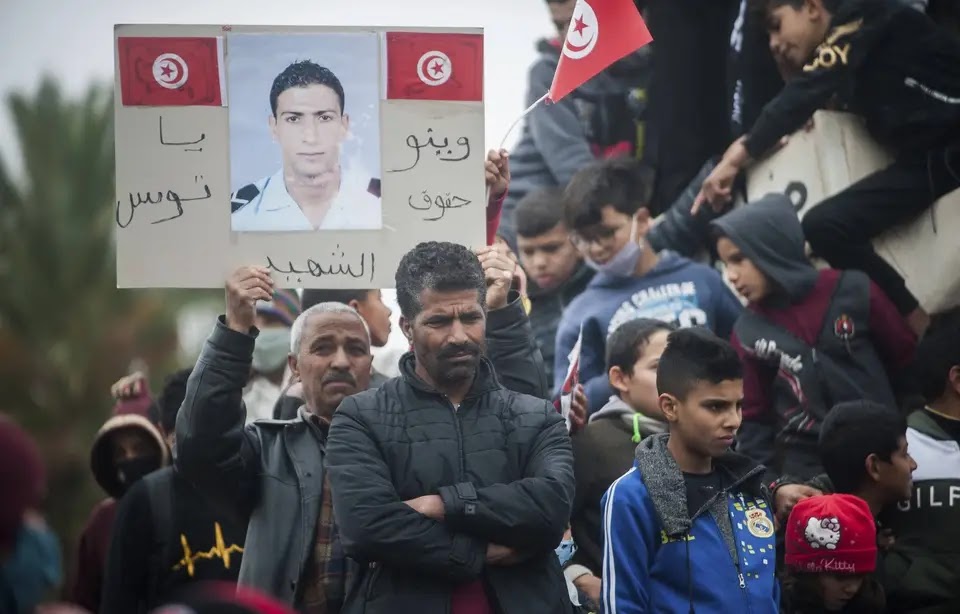
Even though she thought it would go faster, and she sees blockages in recent years, Aude-Annabelle Canesse "refuses to think it's over." Both experts insist that a revolutionary process takes a long time. Especially in the case of a country, Tunisia, which is from afar, without a democratic tradition. "The rebalancing of powers is not complete," observes Amel Boubekeur. Over the past ten years, a culture of protest has emerged and it has never stopped. Because the political landscape froze, it was said that the revolution was over. But on the ground, the revolt continues.
Source:- Flash News and News Agencies